
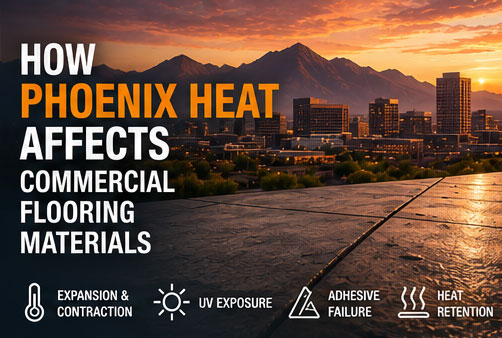
Phoenix businesses operate in one of the most extreme climates in the United States. With summer temperatures regularly exceeding 110°F and intense UV radiation year-round, commercial flooring in Phoenix faces stresses that simply don’t exist in most other parts of the country. While business owners invest heavily in HVAC systems and insulation, flooring is often the last line of defense that gets overlooked — until it starts failing.
Understanding exactly how extreme Arizona heat attacks your flooring materials is the first step to making a smart, long-lasting investment. In this guide, we break down every critical heat-related flooring challenge and explain which materials hold up best in desert conditions.
Expansion and Contraction: The Silent Floor Destroyer
All flooring materials expand when exposed to heat and contract when temperatures cool. In most climates, this movement is minimal and manageable. In Phoenix, it’s a daily battle.
During summer days, concrete subfloors in commercial buildings can reach surface temperatures well above the ambient air temperature. Floating floors — particularly luxury vinyl plank (LVP), laminate, and engineered wood — are especially vulnerable because they are not fixed to the subfloor and have nowhere to go when they expand.
The result of inadequate expansion allowance includes:
- Buckling – planks or tiles push against each other and lift off the floor
- Warping – individual boards curve upward at the edges
- Seam separation – gaps open between tiles or planks
- Edge curling – corners lift away from the subfloor
- Hollow spots – sections of the floor lose contact with the subfloor entirely
Professional commercial flooring contractors in Phoenix account for thermal expansion by leaving proper expansion gaps around the perimeter of every installation and selecting materials rated for high-temperature environments. If your current flooring shows any of these signs, request a professional assessment before the damage spreads.
UV Exposure and Premature Fading
Arizona receives more annual sunshine than almost any other state. For businesses with storefront windows, skylights, or open entryways, UV exposure is a serious threat to flooring appearance and longevity.
UV radiation doesn’t just fade surface colors — it breaks down the chemical bonds in flooring materials, causing them to become brittle, discolored, and structurally weakened over time. Materials most at risk include:
- Carpet fiber – loses color saturation and fiber strength when repeatedly exposed to direct sunlight
- Standard vinyl flooring – yellows and becomes chalky without UV-resistant wear layers
- Rubber flooring – can crack and oxidize under prolonged UV exposure
- Decorative concrete coatings – epoxy and polyurethane finishes degrade without UV-stable topcoats
Commercial-grade flooring products rated for UV exposure include protective wear layers or UV-stable finishes specifically engineered to resist Arizona’s intense sunlight. When selecting flooring for sun-exposed commercial spaces, always request UV performance data from your flooring contractor.
Adhesive Failure in High Temperatures
One of the most common — and most expensive — flooring failures in Phoenix commercial properties is adhesive breakdown. Many flooring products are glued directly to the concrete subfloor using pressure-sensitive adhesives. These adhesives have specific temperature performance ratings, and standard-grade adhesives are not designed for sustained exposure to the heat levels found in Arizona buildings.
Subfloor temperatures in south-facing Phoenix commercial spaces can exceed 90°F even with air conditioning running. In unoccupied areas, temperatures climb higher. When adhesives soften, flooring materials begin to shift, slide, and separate.
Warning signs of adhesive failure include:
- Tiles or planks that move slightly underfoot
- Bubbling or doming in the center of tiles
- Lifting at edges and corners
- Loose seams between adjacent tiles
- A hollow sound when walking on glued-down areas
Professional installers working in Phoenix select heat-resistant adhesive systems tested for desert climate performance. This is a critical specification that separates experienced Arizona flooring contractors from general-purpose installers using standard products.
Heat Retention and Employee Comfort
Different flooring materials absorb and retain heat at dramatically different rates. This affects not only the comfort of employees and customers but also the building’s overall energy efficiency.
Dark tile and polished concrete near exterior windows and entryways can become uncomfortably hot to stand on during peak afternoon hours. Businesses in the service, retail, and hospitality sectors — where employees spend extended periods standing — should factor heat retention into their flooring decisions.
Materials with lower heat retention in Phoenix environments include:
- Carpet tile – provides insulation and remains cooler underfoot
- Rubber flooring – absorbs less heat than hard-surface materials
- Light-colored LVP – reflects more heat than dark-finish products
Conversely, polished concrete and dark tile — while visually dramatic — absorb and radiate significant heat, which can increase cooling loads and reduce employee comfort in high-sun areas.
Best Commercial Flooring Materials for Phoenix Heat
Luxury Vinyl Plank (LVP)
Commercial-grade LVP with a rigid core construction performs exceptionally well in Phoenix. The rigid core prevents the thermal movement that causes standard floating floors to buckle. Use our LVT calculator to estimate materials for your space and get a clear picture of your project investment before committing.
Polished Concrete
Polished and sealed concrete is one of the most heat-stable commercial flooring options available. It doesn’t expand or contract significantly, adhesive failure is not a concern, and with proper sealers, UV degradation is minimal. It’s an especially strong choice for warehouses, retail spaces, and industrial environments. Estimate your concrete flooring project here.
Porcelain and Ceramic Tile
Tile is dimensionally stable in heat and doesn’t expand the way vinyl or laminate products do. With the correct grout and movement joints installed per manufacturer specifications, tile performs reliably in Phoenix commercial applications. Calculate your ceramic tile needs with our free tool.
Commercial Carpet Tile
Carpet tile reduces heat transfer, provides acoustic insulation, and allows for easy section replacement. Individual tiles can be swapped out when damaged by UV or heavy traffic, making long-term maintenance more cost-effective in office environments.
Why Experienced Local Installation Matters
Proper installation is every bit as important as material selection when it comes to Phoenix commercial flooring performance. Contractors must account for:
- Adequate acclimatization time for materials before installation
- Correct expansion gap sizing based on room dimensions and expected temperatures
- Heat-rated adhesive selection matched to specific products and substrates
- UV-protective sealing on vulnerable materials
- Subfloor temperature testing prior to installation
Alliance Flooring Services specializes in commercial flooring installations across the greater Phoenix area, with direct experience managing the unique challenges of Arizona’s extreme climate. Visit us on Google to read reviews from local Phoenix businesses we’ve served.
Ready to Protect Your Phoenix Business Flooring?
Don’t wait until heat damage forces an emergency replacement. Get a free commercial flooring quote today and work with Arizona’s experienced flooring professionals to select materials and installation methods built for the Phoenix climate.