Property managers in Phoenix face a set of flooring challenges that are fundamentally different from those of other business owners. Whether you oversee apartment complexes, HOA common areas, commercial office buildings, or mixed-use properties, flooring decisions directly impact your budget, your tenants’ satisfaction, and your ability to turn units over quickly between occupancies.
After years of working with Phoenix-area property managers, Alliance Flooring Services has identified the core factors that drive smart flooring decisions for multi-unit and commercial properties. Here’s what experienced property managers prioritize — and what you should too.
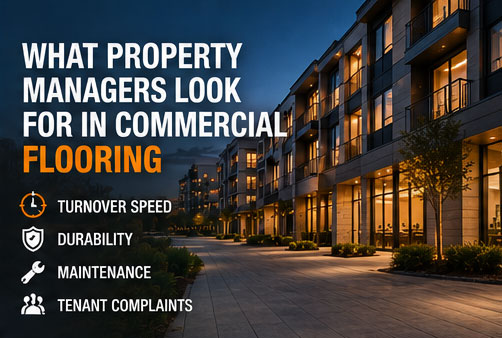
1. Turnover Speed: Getting Units Ready Fast
In property management, vacancy is your biggest cost. Every day a unit sits empty waiting for flooring installation or replacement is revenue lost. This is why turnover speed is consistently the top priority property managers cite when selecting flooring materials and contractors.
What Fast Turnover Looks Like in Flooring
- Luxury Vinyl Plank (LVP) – floats or clicks into place without adhesive cure time; a full apartment can be completed in a single day in many cases
- Carpet tile – individual tiles install quickly, and damaged sections can be replaced in under an hour without matching dye lots or pulling up an entire room
- Modular tile systems – common area flooring that can be maintained section by section rather than replaced entirely
Products that require long adhesive cure times, extensive subfloor prep, or specialized equipment cause delays that property managers cannot afford. Use our LVT calculator to estimate project scope and timeline for your next unit turnover.
2. Durability Across Tenant Cycles
Unlike a business that controls how its own employees treat the floor, property managers must account for a wide range of tenant behaviors. Flooring for rental units and common areas must survive pet traffic, furniture dragging, high-heeled shoes, spilled liquids, and general abuse — year after year and tenant after tenant.
The most durable commercial flooring options for multi-tenant properties in Phoenix include:
- Commercial-grade LVP with 20-mil+ wear layer – resists scratching, denting, and staining from repeated tenant cycles; easy to clean between occupancies
- Polished concrete – nearly indestructible in common areas, lobbies, and hallways where foot traffic is highest
- Porcelain tile – excellent in bathrooms, kitchens, and entryways where moisture and abrasion are constant threats
- Commercial carpet tile – allows targeted replacement of worn sections without a full replacement cost
For common areas that receive the most traffic — lobbies, elevator bays, stairwells, and hallways — our commercial installation teams recommend polished concrete or large-format porcelain tile for its resistance to concentrated foot traffic and ease of nightly cleaning.
3. Maintenance Requirements and Cleaning Costs
Flooring that looks good on day one but requires expensive specialized maintenance quickly erodes the cost savings of a lower upfront price. Property managers track total cost of ownership over the full lifecycle of a flooring material, not just the initial installation cost.
Low-Maintenance Flooring Materials for Property Managers
| Material | Daily Maintenance | Periodic Maintenance | Maintenance Cost Rating |
|---|---|---|---|
| Polished Concrete | Dust mop | Annual resealing | Very Low |
| Porcelain Tile | Damp mop | Grout cleaning | Low |
| Commercial LVP | Dust mop + damp mop | None required | Very Low |
| Commercial Carpet Tile | Vacuum | Spot cleaning, tile replacement | Moderate |
4. Tenant Complaints: The Hidden Flooring Cost
Tenant complaints about flooring are a significant hidden cost in property management. Flooring that creaks, feels hollow, shows wear quickly, or develops odors generates maintenance calls, reduces tenant satisfaction scores, and contributes to turnover. In competitive Phoenix rental markets, visible flooring quality is one of the first things prospective tenants notice during a showing.
Common tenant complaints that can be eliminated with smart flooring selection:
- Noise complaints – LVP over existing subfloors without acoustic underlayment transmits sound between floors; proper underlayment selection eliminates this issue
- Pet odor retention – carpet holds pet odors through multiple tenancies; switching to LVP or tile eliminates retained odor between occupancies
- Flooring movement – improperly installed floating floors creak and shift; professional installation prevents this entirely
- Staining – light-colored carpet in high-traffic areas stains permanently; carpet tile allows targeted replacement
5. Consistent Appearance Across the Property
For HOAs and apartment communities, visual consistency across all units and common areas is important for property value and brand perception. Property managers working with large inventories of units need flooring products that remain in production long enough to replace individual sections without visible dye lot mismatches.
Alliance Flooring Services maintains relationships with commercial flooring manufacturers — including Shaw Floors and Mohawk — to ensure consistent product availability for ongoing property maintenance programs.
Partner with a Flooring Contractor Who Understands Property Management
Property managers need a flooring contractor who communicates clearly, works within tight scheduling windows, minimizes disruption to occupied tenants, and stands behind their installations. Alliance Flooring Services has extensive experience serving Phoenix apartment complexes, commercial properties, and HOAs.
Request a commercial flooring quote or read our Google reviews from property managers who’ve made us their trusted flooring partner.