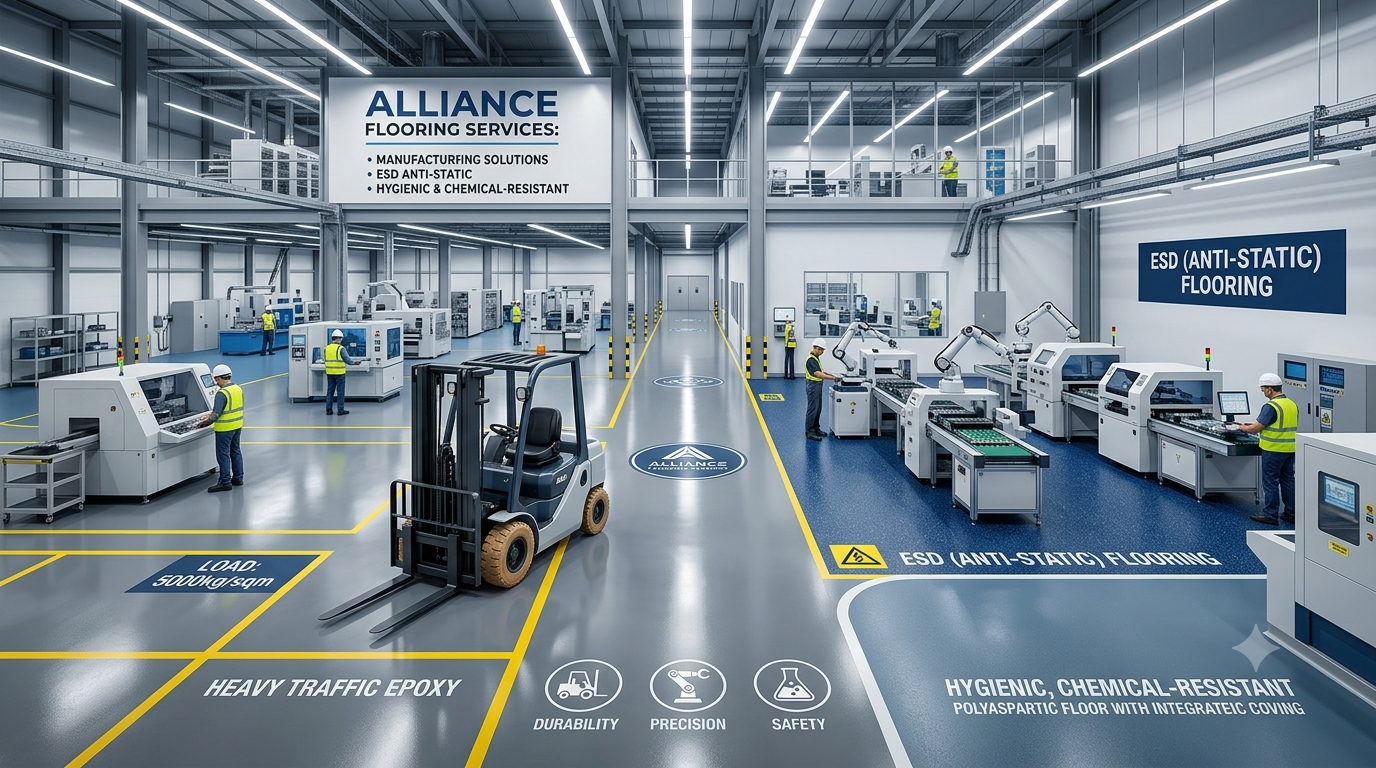
Manufacturing facility flooring has to perform under pressure. Production areas, assembly lines, machine zones, walkways, storage areas, labs, break rooms, restrooms, and offices all need surfaces that match their use. In many facilities, flooring affects safety, cleaning, productivity, and long-term maintenance costs.
Alliance Flooring Services helps Arizona businesses evaluate commercial flooring solutions for demanding environments, including epoxy, resilient flooring, LVT, rubber, ceramic, decorative concrete, and other commercial flooring systems.
Production areas need performance first
Production flooring should be selected around what happens on the floor every day. Foot traffic, rolling carts, forklifts, machinery, vibration, impact, cleaning chemicals, oils, water, and temperature changes can all affect the material. A flooring system that performs well in a clean office may not survive in a production environment.
Manufacturing spaces often need flooring that is durable, cleanable, and compatible with the facility’s operations. Surface preparation, substrate condition, and installation timing are critical.
Epoxy and resinous flooring
Epoxy and resinous flooring are common choices for manufacturing facilities because they can provide a tough, seamless-looking surface in areas that need durability and easier cleaning. Depending on the system, they may be selected for abrasion resistance, chemical resistance, impact resistance, or moisture tolerance.
The exact system should be chosen carefully. A light-duty coating, heavy-duty resinous floor, textured safety finish, and chemical-resistant system are not interchangeable. Product selection should match the facility, not just the desired appearance.
Concrete finishing and decorative concrete
Some facilities use polished, sealed, or decorative concrete in production-adjacent areas, showrooms, corridors, or office zones. Concrete can be a durable and practical surface when the slab is suitable and the finish matches the use.
Existing slab condition matters. Cracks, previous adhesives, moisture, contamination, and unevenness can affect finish quality and performance. A site review helps determine whether concrete finishing is practical.
Specialty needs: ESD, chemical exposure, and cleanability
Some manufacturing spaces have specialty requirements. Electronics production may require electrostatic discharge considerations. Laboratories and processing spaces may need chemical resistance. Food-related facilities may need surfaces that support strict cleaning routines. Wet areas may need texture, drainage, or cove base details.
These needs should be identified early. Specialty flooring can affect budget, product availability, installation methods, and maintenance planning.
Walkways and safety zones
Flooring can help organize movement through a manufacturing facility. Clearly defined walkways, transitions, and color zones can support safer traffic flow between staff, equipment, and visitors. Flooring alone does not create a safety program, but it can support one when coordinated with signage, housekeeping, and facility procedures.
For more on flooring and high-use areas, see our guide to high-traffic commercial flooring.
Offices, break rooms, and restrooms
Manufacturing facilities often include office and employee support areas that need a different flooring approach. LVT, carpet tile, resilient flooring, ceramic tile, and rubber may be appropriate depending on the space. These areas should feel professional and easy to maintain while standing up to staff traffic.
Compare commercial flooring products in our Phoenix product showroom before choosing final finishes.
Plan around uptime
Manufacturing flooring projects often need careful scheduling. Some materials require cure time, ventilation, shutdown windows, equipment movement, or phased installation. A realistic schedule protects productivity and helps prevent damage to newly installed flooring.
Alliance Flooring Services provides Phoenix commercial flooring installation for industrial and commercial facilities. View our project gallery, contact our team, or find us on Google Maps.
Frequently asked questions
What flooring is best for manufacturing facilities?
Epoxy, resinous flooring, sealed concrete, polished concrete, rubber, resilient flooring, and tile may all be considered depending on the facility’s operations.
Do manufacturing floors need chemical resistance?
Some do. Chemical exposure should be reviewed before product selection so the flooring system can be matched to the facility’s actual conditions.
Can manufacturing flooring be installed in phases?
Many projects can be phased to reduce downtime, but phasing depends on equipment layout, traffic patterns, product cure times, and safety requirements.