Sustainable commercial flooring is about more than choosing a product with an eco-friendly label. A truly responsible flooring choice considers durability, maintenance, indoor air quality, repairability, product documentation, waste reduction, and the full lifecycle of the material.
For Phoenix businesses, sustainable flooring should also match the building’s real use. A product that has strong environmental claims but wears out quickly in a high-traffic space may not be the best long-term choice. Alliance Flooring Services helps clients compare practical options through our commercial flooring services.
Durability is a sustainability feature
The longer a floor performs well, the less often it needs to be replaced. Durable flooring can reduce waste, replacement costs, material transport, and downtime. For busy offices, schools, hotels, restaurants, and multifamily properties, durability should be part of any sustainability discussion.
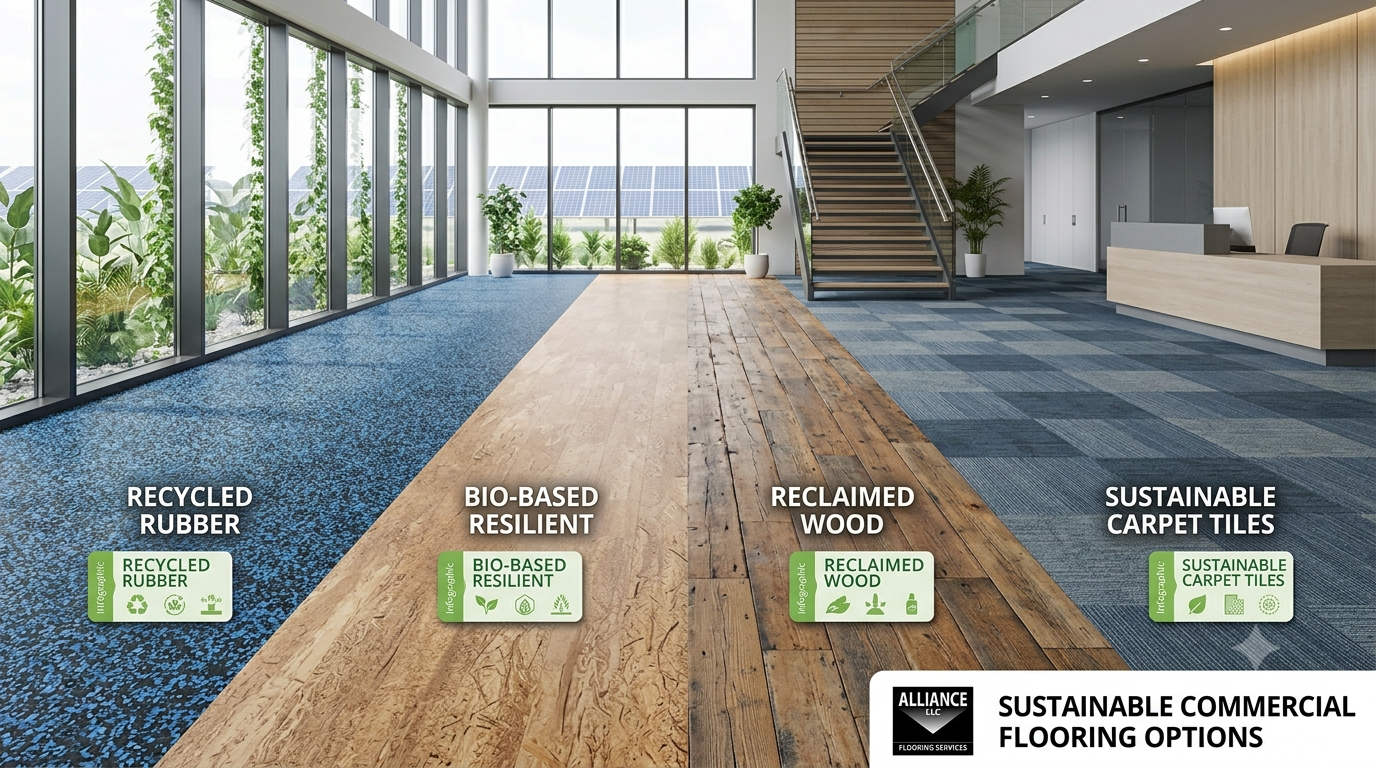
Commercial LVT, carpet tile, resilient flooring, rubber, tile, and polished or decorative concrete can all be evaluated through this lens. The best option depends on traffic, cleaning, moisture, and design goals.
Look for recycled or responsibly sourced content
Many commercial flooring products include recycled content or are manufactured with responsible sourcing practices. Carpet tile, rubber flooring, resilient flooring, and some hard-surface materials may offer documentation that helps project teams compare options.
When sustainability goals matter, ask for manufacturer documentation instead of relying on marketing language alone. Product declarations, recycled content information, emission certifications, and maintenance guidelines can help owners make better decisions.
Low-emission flooring and indoor air quality
Indoor air quality matters in offices, schools, healthcare spaces, hotels, and other occupied buildings. Flooring materials, adhesives, finishes, and cleaning products should be reviewed for emissions and compatibility with the project’s indoor air quality goals.
Low-emission products can support healthier interiors, but installation conditions and maintenance products should also be considered. A low-emission floor paired with the wrong adhesive or cleaning routine may not deliver the intended result.
Repairable flooring can reduce waste
Products that can be repaired in sections may help extend floor life. Carpet tile and some LVT systems are popular for commercial settings because damaged areas can often be replaced without removing the entire floor. This can be especially valuable in offices, corridors, apartment common areas, and hospitality spaces.
Repairability also helps facility teams manage budgets. Instead of waiting until the entire floor looks worn, they can address high-use zones first.
Maintenance affects sustainability
A sustainable flooring plan should include realistic maintenance. Some materials require specific cleaners, finishes, machines, or maintenance intervals. Others may reduce chemical use or simplify cleaning. The right choice depends on the facility team and how the space is used.
If the building cannot maintain a product properly, the floor may fail early. That shortens the lifecycle and weakens the sustainability case.
Concrete and existing-floor strategies
In some projects, working with an existing concrete slab may reduce the need for additional finish materials. Polished, sealed, or decorative concrete can be a practical option when the slab condition supports it. This is not right for every space, but it can be worth evaluating during renovations.
Existing flooring may also be removed selectively or replaced in phases to reduce waste and disruption.
Compare sustainable options in person
Sustainability should not be separated from performance. The best commercial floor should support environmental goals while still handling daily traffic, cleaning, safety, and design needs. Visit our product showroom to compare commercial flooring materials, or review examples in our flooring gallery.
Alliance Flooring Services provides Phoenix commercial flooring installation for businesses across Arizona. Contact us to discuss sustainable flooring options, or view our location on Google Maps.
Frequently asked questions
What makes commercial flooring sustainable?
Sustainable flooring may include durability, recycled content, low emissions, repairability, responsible sourcing, efficient maintenance, and reduced replacement waste.
Is LVT a sustainable flooring option?
Some LVT products may support sustainability goals through durability, long service life, documentation, and repairability, but product details should be reviewed.
Why does maintenance matter for sustainable flooring?
Proper maintenance helps flooring last longer, which can reduce waste, replacement frequency, and lifecycle costs.